|
Dear friend,
As a kid, I remember swimming in the Missouri river in my home community of Lower Brule, South Dakota, the Kul Wicasa Oyate. I remember it being both odd and fascinating that I could walk out into the water quite a way and my feet still be able to touch the ground. At 30-40 feet out I could look back onto the shore with amazement, feeling the muddy water beneath my feet. My uncle told me, “The old community used to be here, now it's under water.” I remember thinking why did this happen, was it just that way, that we were unlucky enough to live in a place that experienced flooding and the water never receded? Much later in life, I learned about the “Pick-Sloan Plan” and its impact on my homelands and all native lands up and down the Missouri River. From inception to implementation of this federal scheme, political power and participation was denied to the peoples of the Three Affiliated Tribes. Land was stolen, hundreds of families were displaced (with a push from the US movement toward urban areas), more coercive legislation was enacted, and entire ways of living were lost.
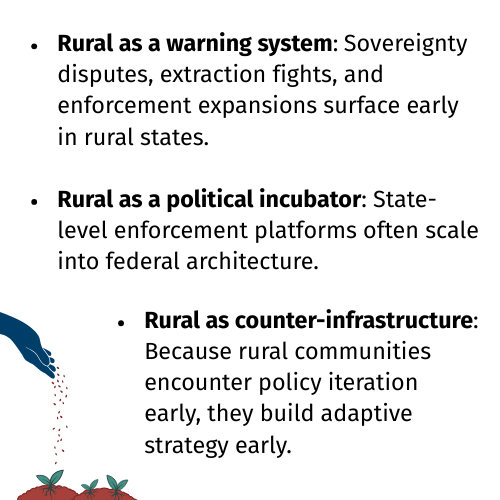
Rural communities, particularly Native communities, have repeatedly served as proving grounds for jurisdictional expansion of state and federal power; intentional displacement of Native peoples and others in the name of natural resource extraction, white settlement, and economic growth; and erosion of tribal nations’ sovereignty. While policies such as the Pick-Sloan Plan in the 1940s reshaped the entire Midwest, changes were particularly acute in rural regions across the states both demographically and structurally. Despite the relocation plans, communities reorganized themselves, and built much needed resistance infrastructure, such as community patrols monitoring police brutality, legal defense networks, clinics, schools, and multiracial alliances built among the American Indian Movement (AIM), Black Panther Party, and Chicano movements. Their goals were not simply to protest, rather to build power and adaptive governance under the pressure of mounting state violence.
To me, the history of building resistance infrastructure connects directly with the resistance infrastructure grassroots organizers are building today, with multiracial alliances as a front line defense against the authoritarian regime and state tactics ICE is using to intimidate, incarcerate, and relocate people. Across the country, people in rural and urban areas alike, are creating their own community defense strategies and tactics, just like the ones my community continues to build.
|