

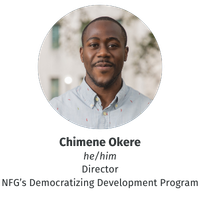
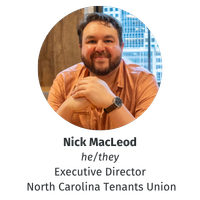
As part of NFG’s Democratizing Development Program’s (DDP) newsletter series on the intersection between housing justice and democracy, we're featuring stories from across the country that reveal not just who benefits from the housing crisis, from rising land prices to deplorable living conditions; but also the community organizing that weaves neighbors together in an effort to build power and foster self-determination. In this interview, DDP Director, Chimene Okere, is in conversation with Nick MacLeod, Executive Director of the North Carolina Tenant Union (NTCU).
About North Carolina Tenant Union
North Carolina Tenants Union seeks to build a housing system that prioritizes people over profit. To transform the housing system, NCTU members organize grassroots organizing campaigns led by directly-affected tenants to stop displacement, win critical repairs, stop rent increases, democratically control their housing and strengthen tenants’ rights.
This conversation has been edited for clarity and length.
1. What’s your vision for building a majoritarian base in a state with such geographic and political diversity?
As anybody who has lived with rats knows, getting rid of the damn rats is a remarkably effective unifier. And, I’ve never met a rat that went into a Democrat’s apartment but not a Republican’s, or ignores the mobile homes of citizens but love to eat undocumented folks’ groceries.
None of this is to say that it’s easy to build across differences. We spend a huge amount of our time navigating dynamics within complexes; identifying the right leaders for a given group of tenants, first building trust directly and then facilitating trust between those leaders. It’s slow and not at all a straight line.
But, the advantage that we have is that we get to tell the truth. I’ve said the phrase, “I’m not asking y’all to like each other, I’m asking if you can win without them” more times than I can remember.
The beauty of tenant organizing is that it’s inextricable from an undeniable, shared material reality. It doesn’t matter if your apartment gets sprayed for roaches if your next door neighbor’s isn’t. Those roaches are coming back. If the mold in your bathroom gets fixed but your upstairs neighbor’s tub isn’t, that mold is coming back.
Tenants' interests aren't collective in the abstract, they literally have to be collective because of how bugs and gravity work. Starting and staying rooted in that shared need lets us knit trust across otherwise impassable gulfs. With that basic scaffolding built, tenants’ politics and worldviews change through the inevitable hours of meetings and shared meals, and the felt sense of solidarity that comes through building a democratic union together and then wielding that power to take care of yourselves, together.
This resonates based on my experience as a grantmaker and funder organizer! I’m not asking whether a funder's strategy can solve the crisis of democracy. I’m asking whether it’s possible to address deep distrust in our country's democratic institutions without funding organizing. Your grantmaking strategy to ensure access to voting is materially less effective if people don't believe you can help them keep a safe and affordable roof over their head.
The short version is: We need more power than the NC Apartment Association, The Home Builders, The NC Realtors and the NC Manufactured Housing Association combined. Those four landlord lobbyist groups have de facto written much of our landlord-tenant law.
2. What’s the main obstacle to building a housing system that prioritizes people’s needs over profits? How can funders support your organization's approach in building that housing system?
That law prioritizes the profit of a few landlords over the ability of tenants to breathe air without mold, to not freeze in the winter or boil in the summer, or to not share their homes with unwelcome rats and bedbugs. They have that power because they are extremely well organized into durable institutions and well resourced. They can reliably move large sums of money to help or harm a given politician. They can dominate the public narrative with threats of a capital strike (i.e. they’ll stop building or investing if this tenant protection goes through). There’s a lot of useful things to learn from how they’ve built their power – that durability matters, that scale matters, that narrative matters and, crucially, that reliable resources makes all of that possible.
I’m hearing you name three core lessons from the power that they’ve built: predictable resources, durable institutions, and clear narrative discipline. Specifically a salient narrative that affirms that regardless of who you are, EVERYONE deserves a home where you can breathe the air, water and heat are available year-round, and pest free.
I’d start with the obvious and extremely important; that lower-case democracy is hard, it’s messy, it’s not always linear and it involves a bunch of meetings and a bunch of 1-1s. But, NCTU is a democracy not just because we believe in it, but because it’s a practical necessity. That’s for three main reasons:
3. What's your advice for other movement organizations looking to make this connection between lower-case democracy and upper case?
- First, all our wins are because members fought to defend themselves and their homes. That doesn’t happen if we float in from on high and tell them to care about zoning regulations or subsidy levels for Low-Income Housing Tax Credit (LIHTC) properties. We need our members to push our work forward, and they’re only going to do that if they’re driving.
- Second is, that the folks closest do just understand what needs to happen better than anyone. Our job is to provide the scaffolding and context, but folks who have been living on the losing end of a power dynamic their whole lives can grasp the bigger power dynamic at play quicker than anyone else.
- Third is that this work is slow and we only win with durable, persistent organizations. The best way to build those, in our experience, is to make the process of the fight producing dignity in and of itself. An old mentor of mine used to say, “Organizing done well creates dignity, even if you don’t win.” That’s beautiful for it’s own sake, but it’s also the key to building organizations that last long enough to ultimately win, even after many rounds of losing.
Beyond the internal process pieces and into knitting lower-case democracy into upper-case democracy, the biggest thing is that the connection needs to be legible and concrete. It needs to be directly related to something they already care about. And, it needs to be important enough to them that they’re willing to take on the risks and burdens of getting into the fight. The only way to know if any of that is true is to spend a lot of time listening first and then building the political education and the policy work off of what folks already know and care about.
I’ll wrap up with an example – Our leaders in Durham won the No Rent for Slumlords Ordinance, which changed the process to get back rent for living in dangerous conditions from an impossible maze to a straight line, and made it so tenants could get back 300% of the rent, because they were in building-level fights and hitting a wall. The same thing happened all over, but I’ll focus on Ashton Place. The organizing there started after Ms. Debra’s son, Jason, got trapped in the laundry room by a faulty door with only an electronic lock. With no glass in the door and no way to get out, he tried to escape for 45 minutes until ultimately he died of heart failure. And, as Ms. Debra is quick to point out, their landlord didn’t fix that door for another month. Ms. Debra turned her grief into action and, with her neighbors, built Ashton Seniors in Action. They were able to win some initial repairs; some new lights, fresh paint. Real, but not the things that were making folks unsafe. Not what had killed Jason.
They understood that they needed real, enforceable leverage to get the bigger wins done. Their analysis drove NCTU’s push for No Rent for Slumlords. They showed up to the work sessions, testified at hearings, and when we won with a unanimous vote, they started singing gospel in the council chamber. Immediately, they turned around and told their landlord, ‘You need to follow this law that we won’ and that’s gotten them into active negotiations.
So, the policy needed to come from their own analysis and then it needed to be useful in their own context. That’s why they fought to win it and that’s why it was worth winning.
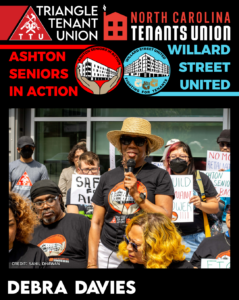
And, to come full circle on lower-case democracy, Ms. Debra was just elected to our board to represent Ashton Seniors in Action.
You’re saying democracy is not experienced in a vacuum and that a society’s understanding of a democracy's usefulness relates to whether it addresses material realities and brings people into closer relationships with their neighbors. If that’s the case then when funders are making the case to restore democracy to their boards and leadership, funding your organization’s work can encourage engagement in other civic institutions- zoning boards, city councils, permitting ordinances, and political elections. Thank you, Nick
Posted 09/03/2026 in
Share