

Communities across the United States continue to face federal occupation as ICE, the National Guard, and other federal agencies take over our cities. If you’re a philanthropic leader in smaller communities that don’t get the same national attention as New York, the Bay Area, Los Angeles, Chicago, or the Twin Cities, you may not be sure how your resourcing can most effectively protect your neighbors.
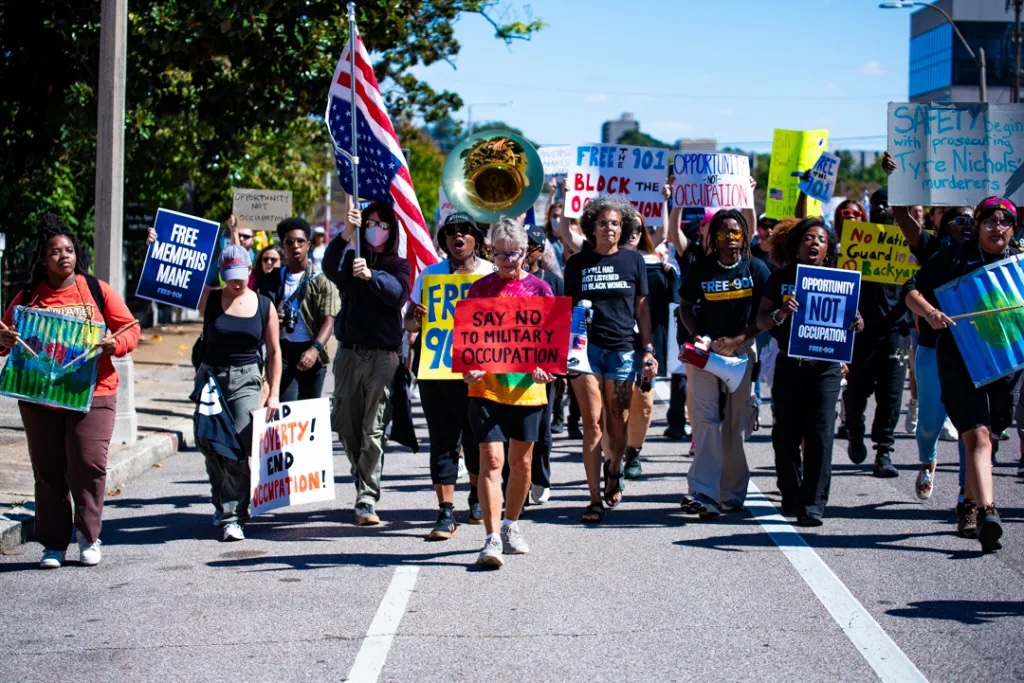
In January, NFG hosted a conversation with organizers in Memphis to help funders scale their impact in the face of the mass deportation campaign waged by local and national authorities. Organizers in Memphis, Tennessee shared what it’s been like to see ICE, DHS, National Guard, IRS, police and local authorities, and state legislatures ignore the will of local communities and increase policing and surveillance of Black, brown, and low-income communities. Groups connected with the Free901 Campaign highlighted why funding individual organizations and volunteer networks promote community safety and the relational work between groups to sustain long-term systems change.
Specifically they shared that funders should:
- Get educated about collaboration agreements between federal agencies such as DHS, FBI, DEA, and IRS and your local community- Find out if your local and state government is supporting these agencies, by leasing land for detention facilities, sharing data, training federal agents in violence, and incentivizing police to cooperate with DHS. 287(g) agreements have been used to facilitate greater coordination between local and federal authorities to harass Black and brown residents.
- Learn from funders advancing community safety- The long history of criminalization of Black, brown, and low-income communities sowed the seeds for today. Memphis organizers have been advancing policy change at the local and state level to prevent ICE’s use of unmarked cars, traffic stops, and no-knock warrants. Fund counteracting local organizing and policy advocacy in your community.
- Ask grantees about opportunities to invest in long term infrastructure- Your current grantees, no doubt, collaborate with a litany of partners. Some may be volunteer mutual aid networks, bail funds, 501c3’s, or partner with 501c4’s. Ask if there are ways that you can support them. If philanthropy doesn't broaden its current scope of giving beyond grants, those relationships will be further tested in the upcoming months and may hamper the long-term success of current grantees.
- Invest in cross-state coalitions- Memphis organizers relayed the importance of a strong coalition to support rural and suburban communities that adapt interventions for their unique context. It’s crucial to invest in leaders and organizations that can share lessons with other communities so that counter-strategies stick.
- Learn about (and resource) Abolition- Tactics like ICE watch, rapid response, emergency responders for people experiencing mental health episodes, school patrols, have been used by abolitionist organizations to end the need for police in communities. Finding pathways for bringing this work into your long-term portfolio will be crucial to ensure the energy of this moment translates into less policing and more safety.
As Nwamaka Agbo, CEO of the Kataly Foundation, an NFG member, put it, “We will never reform, or even move incrementally out of this moment, through false solutions like body cameras, additional training for law enforcement, or removing masks. Those tactics are intended to provide a false sense of control and repair when in truth ICE and law enforcement never should have been given the authority, weapons, and budget to enable the continued murder and criminalization of poor Black and Brown people.”
We invite funders to reach out to your program contacts at NFG to ask how you can fund similar solutions in your communities. Ask yourself:
- What conditions in Memphis are similar or different from your local context?
- What are the implications and roles for all funders in your community, including those who might not think of themselves as funders who fund “organizing” work but fund food security, health, housing, childcare?
- How are you engaging them, funder to funder, to meet this moment?
Whether your institution is place-based, regional, or national, making the case to fund the above strategies can help protect your neighbors. Funders should learn how their community has enabled narratives and policies that increase surveillance and policing of Black and brown neighbors and coordinate with peers to increase support for long-term policy advocacy. To continue to learn about the conditions in Memphis and donate to local organizations, please refer to this resource list. A password-protected recording of the webinar can be found here. Reach out to Chimene ([email protected]) to receive the password.
Posted 03/18/2026 in
Share