

FJE organizes funders to support economic and worker justice campaigns that improve worker health and safety, job quality, and ensure workers and their communities can build power.
The program explores the impact of racial capitalism as a barrier to shifting power, such as concentrated power in corporations and dominant white supremacist, hetero-patriarchal ideologies. Through a core set of briefing, learning visits, and member-driven strategy sessions, FJE provides a range of opportunities for funders, community organizations, and labor organizations to work together and align their efforts.
Get in touch to find out more

For more than 50 years, the economy has benefited from high productivity while the American working class’ real wages have faced significant stagnation, resulting in rampant inequality. New employment practices and surveillance technology have contributed to a rapidly changing nature of work, with increasingly unstable employment relationships, a lack of accountability along complex hiring chains, rampant misclassification, and the explosion of fissured, subcontracted and temporary work arrangements. Challenges for workers accelerated due to the COVID-19 pandemic, the crippling racial and gender gaps in wealth, income, and political influence, rising fascism, and the deteriorating conditions for Black, Indigenous, and people of color, low-income communities and workers, rural communities, LGBTQIA people, women, and immigrants.
In response, community members and workers have been increasingly organizing, demonstrating, and striking for protections and real solutions to bring relief in the shorter term, and a just recovery in the longer term. They are calling for a new vision for justice and safety free from police violence and sexual violence, toward a vision that creates economic security and promotes physical, mental and environmental health.
FJE programming is currently focused on the following two program areas:
- Meeting the Moment, which creates collaborations for a just future of workers that also addresses long-term racial, gender and climate justice, and
- Working at the Intersections, which investigates and highlights economic discrimination and disparities based on race, gender, and migration status; including how philanthropy may perpetuate these disparities through its grantmaking, employment practices, and opportunities for advancement.
In all aspects of FJE’s work, we are committed to placing organized labor, worker centers, worker justice campaigns, policy efforts, collective bargaining and negotiating power and organizing strategies at the center of our work, as well as addressing the disparate impact of economic policies on people of color, women, migrants, the LGBTQIA community, and low-income individuals and families.
The Current State for Workers
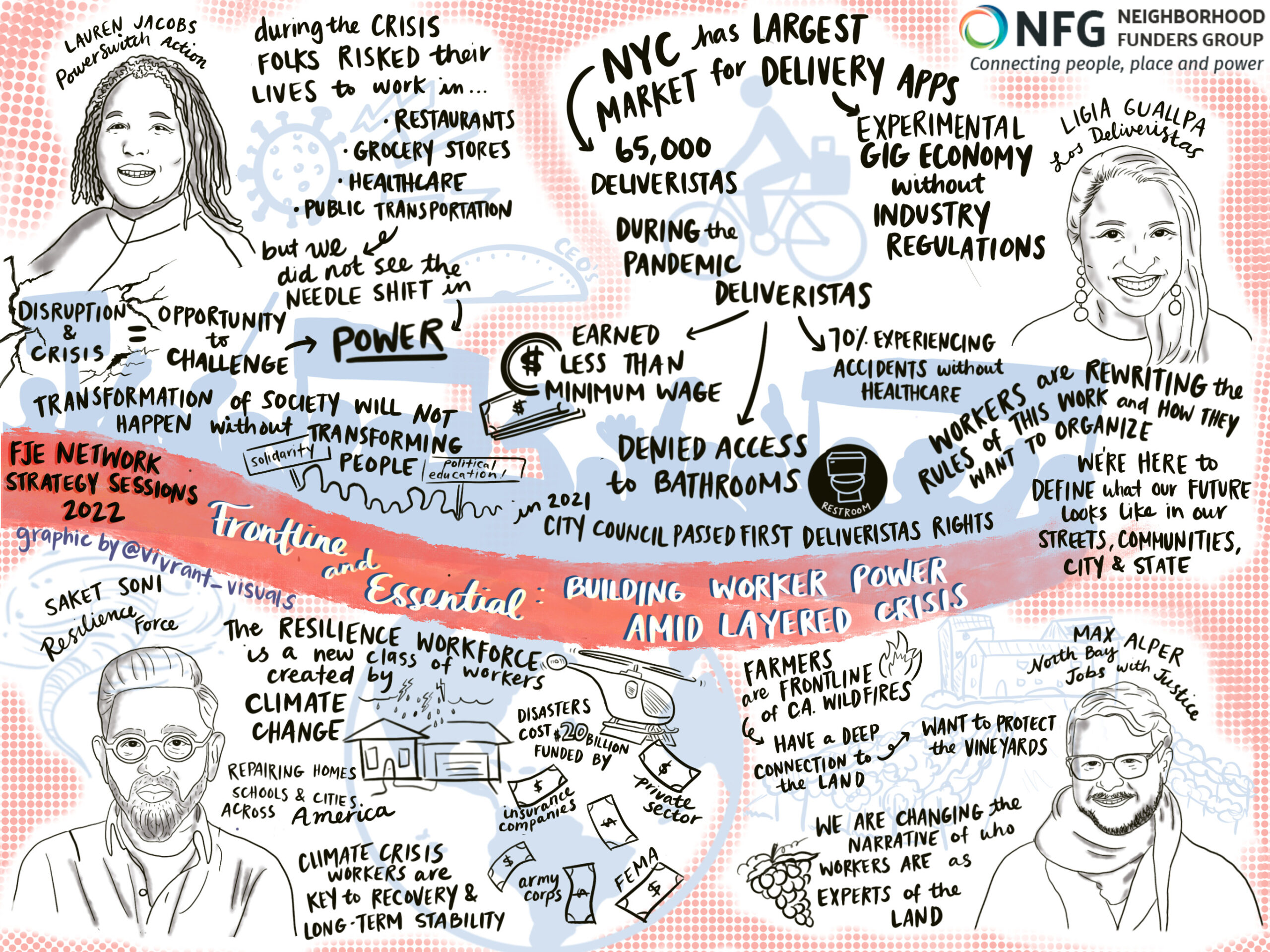
As we enter several years after the start of a global pandemic, workers everywhere are in a fight for their lives: for their physical and mental health, for protections on the job and in their communities, and for economic security and social protections. Workers are sounding the alarm that this country’s deep allegiance to racial capitalism, white supremacy, and heteropatriarchy crushes democracy. Additionally, corporations and the wealthy have seen unimaginable profits since the beginning of the pandemic, amassing money and power while ensuring inflation and a higher cost of living for the rest of us.
Considering these conditions, workers have more leverage than they have had in many years. More workers are unionizing and building power in industries across the U.S. to resolve the myriad crises facing our communities: fires, storms and infrastructure failures, evictions, deepening debt, school closures, family care challenges, violence and suppression by the police and ICE, continued extraction of resources and capital, and workplace exploitation.
Philanthropy will need to be more organized than ever in order to bring the resources to bear to support the success of our movement partners.
Funder Learning & Collective Action
FJE hosts a Racial Capitalism Community of Practice (CoP) open to funder members. Through this CoP, funder participants explore how we can deepen our grantmaking efforts to advance justice, incorporate anti-racist practices in philanthropy, and partner with movement leaders in the creation of an inclusive economy.
Sessions focus on political education and building shared understanding of the framework of racial capitalism, deepening relationships with one another, and cultivating a project around shifting philanthropic practices. This is typically an annual five part series, meeting for three hours every three weeks.
We ask participants to join the series in teams of three people from their institution, to support project ideation and implementation. If you have a project you have been thinking about or working on, this is an ideal space for workshopping and execution. If you are not sure yet of what a project would be but want to learn more deeply and collaborate with your colleagues, this is also the space for you.