

NFG’s New York Rural Organizing Portfolio came online as the conditions for building rural power became even more untenable. The work of rural organizers was already off the radar of much of philanthropy and dramatically under-resourced; at a time they found themselves having to urgently fundraise while navigating our generation’s most challenging and rapidly changing attacks on immigrants, rural communities, and the nonprofit ecosystem more broadly.
Integrated Rural Strategies Group (IRSG) stepped up and organized funders to coordinate and mobilize resources with a bird’s eye view of community and grantmaking ecosystems because of real relationships the IRSG had built with funders and organizers as steering committee members and movement advisors that had a keen sense of how and where to deploy funding to strengthen the rural community organizing ecosystem across New York State.
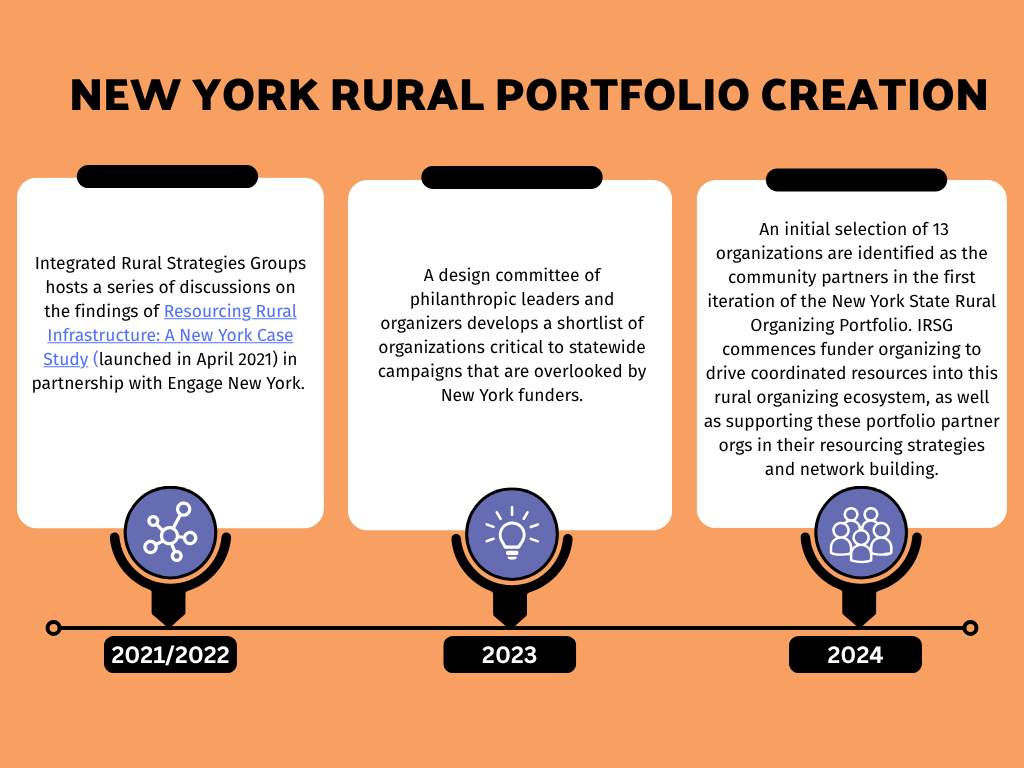
Those relationships are an evolution of a partnership with Engage New York, including our April 2021 report, which documented the capacities and impact of New York’s rural organizing ecosystem. The New York Rural Organizing Portfolio sought to actualize the report’s findings and recommendations, and was later launched in June 2024. Since that time, IRSG has partnered with 18 funders to mobilize nearly $1M in aligned, pooled funding for this critical ecosystem of power builders.
Our groundwork has surfaced grassroots community-based groups who, during the attacks of the past year, have provided essential support, including court accompaniment, rapid response, accurate information in multiple languages, legal navigation, food, and educational support in New York’s most rural regions. This is rural community organizing doing what it does — using its capacity to adapt to immense and rapidly shifting challenges, with limited resources and on the periphery of philanthropic strategy.
Right now, IRSG continues actively organizing funders to resource these groups, mobilizing funding that has, in some cases, kept their lights on and sustained their work to keep community members connected to school, work, and one another amid heightened immigration enforcement in the past year. These efforts profoundly demonstrate what is possible when rural groups are resourced as a part of a robust, statewide ecosystem that can deliver progressive power when coupled with amenable leadership at the city and state level.
Coordinating the Deployment of Nearly $1M to Support Community Organizing and Crisis Response Across Rural New York
Funding partners to the Rural Organizing Portfolio, such as the Ralph E. Ogden Foundation, have provided funds ranging from $5,000 to $25,000 apiece to leverage the collective impact of the Portfolio’s coordinated resourcing strategy. These funders have also entered into relationships with new rural community partners. This method of relational giving has sustained critical organizations that provide wraparound support at the moments they need reinforcement most.
"Our foundation is located just 60 miles north of New York City, yet we are painfully aware of the lack of resources and funding for rural organizing in New York State. We know that rural organizers face unique hurdles, such as access to internet, and large geographic distances between rural communities that can make in-person meetings challenging. Through our long-time relationship with NFG, we've been able to provide small but impactful grants to rural organizers in our state. In 2024, NFG reached out to us to tell us about Mujeres Divinas, and we were able to support them with a grant to sustain their organizing amidst a downturn in funding. Even though our grant was small, it had an immense impact as it allowed Mujeres Divinas, to secure further funding to resource their important farmworker organizing in the Finger Lakes Region.
Last year, we were able to support Columbia County Sanctuary Movement with a rapid response grant so that they could continue their critical immigration justice work in our region thanks to the organizing of the rural portfolio. These grants were only possible through the trust built between funder networks and rural organizers in our state. We know that the future of New York, and our country, is dependent on how strong our rural communities are.”
Charlotte Dillon and Bea Stern, Ralph E. Ogden Foundation
Navigating An Unprecedented Level of Attacks with Flexibility and Trust
In partnering with IRSG’s Rural Organizing Portfolio, Ralph E. Ogden Foundation was able to move resources to critical rural grassroots work, knowing that their relatively small amounts of funding were amplified through the Portfolio’s coordinated ecosystem resourcing strategy.
Organizations like the Workers’ Center of Central New York (WCCNY) have had to adapt their work from seasonal visas and advocacy on injury cases for painters and construction workers to work permits, asylum cases, and special status hearings for detained children and people held without bond. Through our partnership with funders such as the Four Freedoms Fund and the Central New York Community Foundation, funding support has been adaptive as well and expanded WCCNY’s staff capacity to partner with regional legal advocacy groups and to preventatively complete family preparedness documentation, and put monitoring systems in place to force immigration courts to hold bond hearings for community members who disappear on their way to or from home and work.
“Migrant farmworkers are essential to our five-county region's agricultural economy, yet too often lack the protections and support they deserve. Our grant to the Workers' Center of CNY through our partnership with IRSG's Rural Organizing portfolio helped build the staff capacity needed to organize workers around health, safety, wage equity, and the formation of worker committees that strengthen both working and living conditions. Strong rural economies must include and protect the workers who sustain them.”
- Qiana Williams, The Central New York Community Foundation
2.0 Strategy for IRSG’s New York Rural Organizing Portfolio
Our funding partnerships through the Portfolio over the past two years has primarily been with funders unlocking discretionary small grants, and coordinating their deployment to meet the dynamic work of rural organizing groups as they navigate defensive strategies in a period of deepening crisis. This approach has democratized the resources going into the ecosystem, helping ensure no orgs or communities get “left out” of the pie.
We have observed positive shifts in the postures of the funders, including an increased flexibility to meet the needs of Portfolio groups, albeit slowly and, at times, not quickly enough. Critical Black-led organizations like Black Love Resists in the Rust and Alliance of Families for Justice closed their doors last year, despite being resourced by funders in the portfolio, because of a documented trend in philanthropy to defund Black-led organizing. Amidst this backdrop, an outcome of our organizing has been a commitment to lasting partnerships with the groups funders have supported, along with clarity on moving consequential dollars through sustained gifts over time and additional organized gifts from their peers, allowing us to provide support for new organizations also facing financial cliffs. Together, these smaller dollars fuel resistance in New York’s rural counties and allow them to more effectively and equitably engage with their counterparts in other cities, including New York’s most populous city, where together collectively, these groups are able to partner to combat exploitation at the state level.
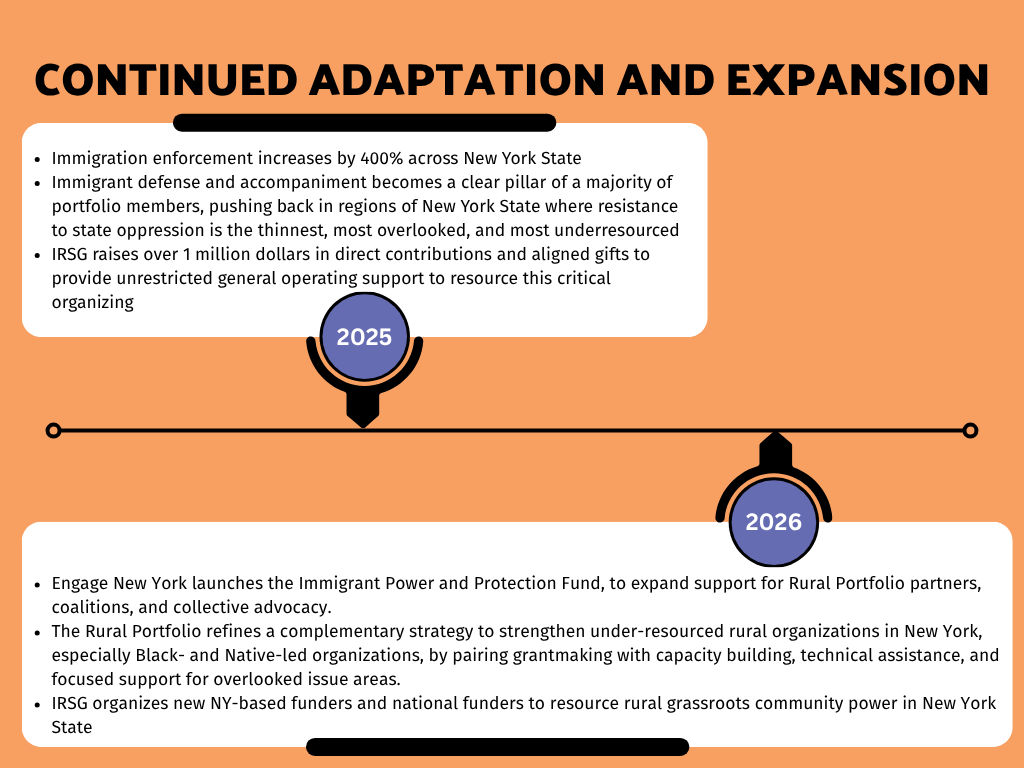
As we move into the next phase of resourcing New York’s Rural Portfolio, we are focused on sustaining resourcing to the existing rural organizing ecosystem we have become acquainted with across the state; coordinating with and leveraging the new collective resourcing capacities of partners like Engage New York and its Immigrant Power and Protection Fund; organizing with funders outside of the state to partner with us as a trusted intermediary to bring critical resources to the grassroots; and keeping an eye toward driving resources to additional rural geographies in which organizing and power building capacities remain un- and under-developed.
If you would like to learn more or join us as a funder of the New York Rural Portfolio, please contact Integrated Rural Strategies Group's Director, Lindsay Ryder.
Posted 03/30/2026 in
Share